

How Golf Became the Coolest “New” Sport Again
Golf used to be the poster child for exclusivity.
I’m talking private, swanky clubs, $100+ greens fees, and a reputation that made newcomers feel like they needed an invite just to swing.
But something is changing.
The sport that once demanded a collared shirt and half your weekend has become…more fun, more flexible, and more accessible than ever.
From simulator lounges to growing YouTube golf collectives, as well as next-gen franchises like Another Nine, the game is in the middle of a full-blown culture flip.
And I feel like this new era of golf feels like it’s less about prestige and more about participation.
So what’s behind the shift, anyway?
And what can investors, operators, and even casual golfers learn from the rebrand of one of America’s most traditional pastimes?
I’ve scraped together all the insights that tell the story of golf’s current evolution. Let’s discuss.
Why Golf Needed a Rebrand
For decades and decades, golf thrived on exclusivity.
The course itself was the gatekeeper since it’s typically expensive to join, hard to maintain, and limited by weather and daylight.
Between 2010 and 2020, more than 800 US courses closed, which is about a 11% decline in supply, while new course development became almost nonexistent.
It’s not that interest in golf disappeared…in fact, the demand has only increased, but the traditional model just hasn’t been able to keep up with modern life.
Fast-forward to today: 48 million Americans played golf in 2024, which is the highest participation ever recorded.
That is an incredibly interesting stat, but the even bigger twist here is that more people played off-course (in simulators, ranges, and entertainment venues) than on traditional greens.
The modern player is chasing a good time more than a low handicap.
They want golf that fits into their schedule and not the other way around, so that naturally means shorter sessions, smaller groups, and settings that welcome beginners as much as veterans.
The way I see it, that’s what makes this moment so fascinating: the sport grew by reinventing the setting, not the swing.
As a result, off-course (or simulator) golf participation has surged 73% since 2019, proving that people crave golf on their own terms.
Private Suites, Public Appeal

If the old guard of golf was defined by blazers, velvet ropes, and quiet fairways, the new guard is about wearing whatever suits your comfort level, private suites, and all-around fun.
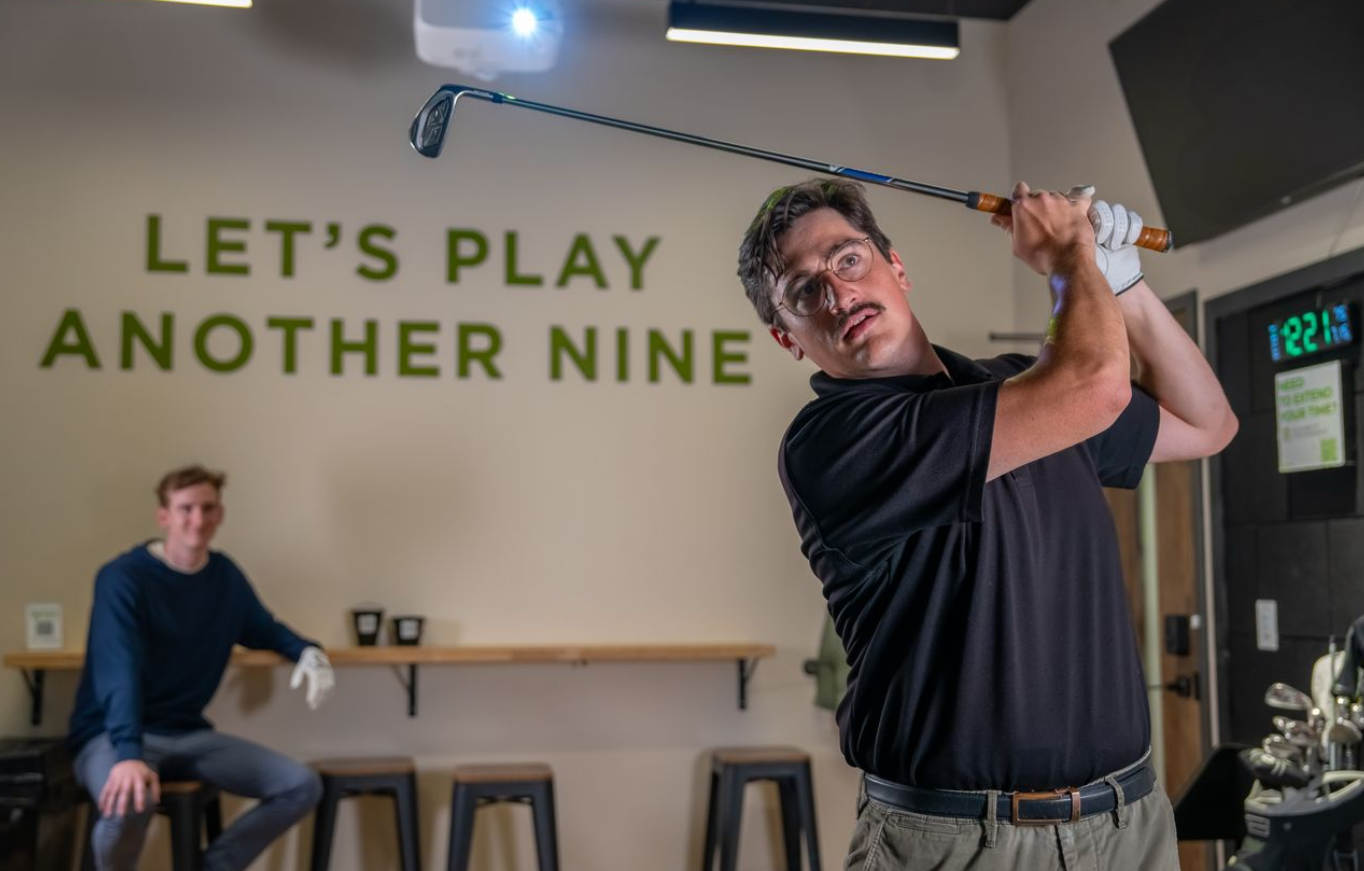
At Another Nine, the vibe feels more boutique lounge meets cutting-edge simulator lab than your dad’s country club.
Each location is made up of all-private simulator suites, open 24/7, and powered by TrackMan technology that replicates more than 350 world-class courses.
There’s no dress code or random pairings either…just you and whoever you invite.
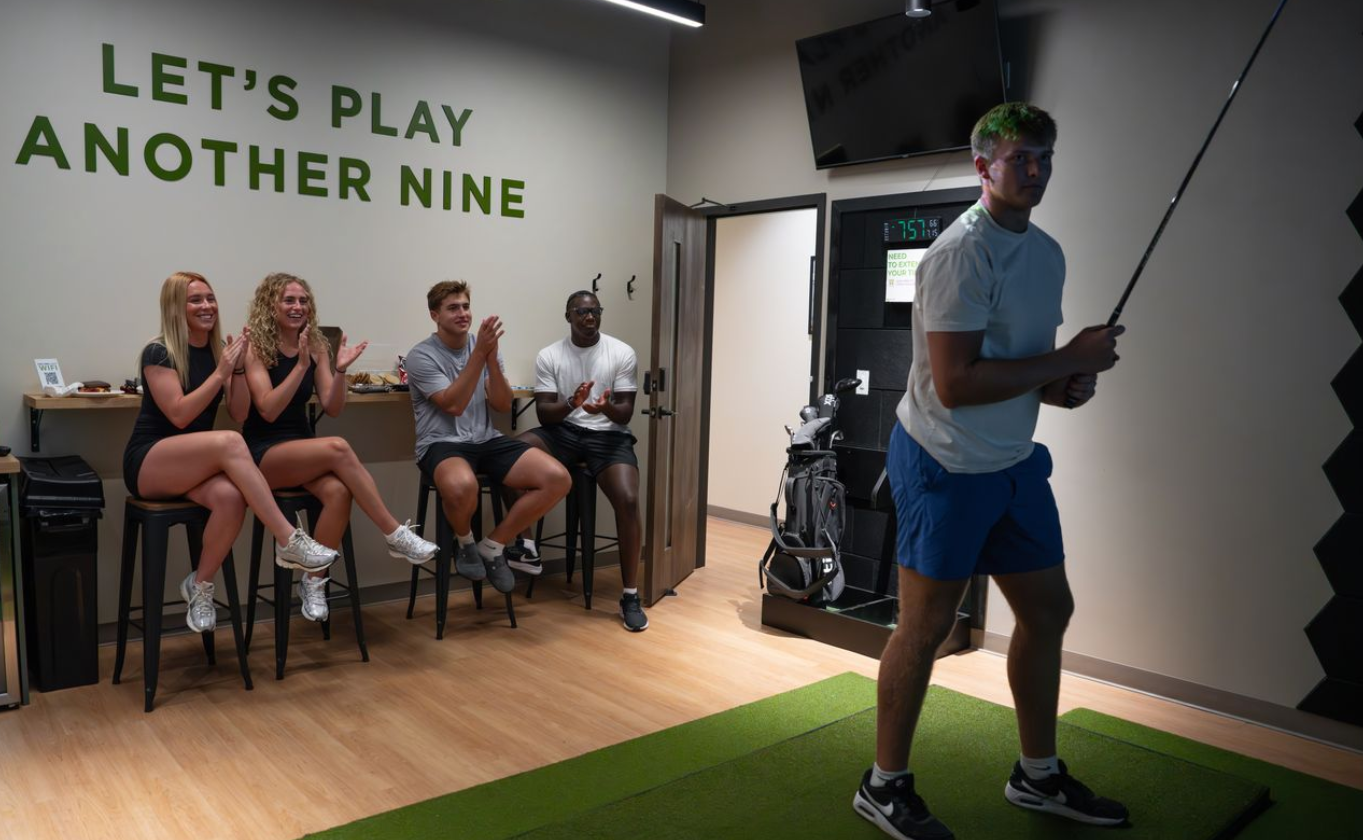
Instead of clinking glasses in a crowded bar, guests bring their own drinks, pick their own music, and control their own space.
It’s golf, remixed for comfort and community.
The rise of YouTube golf creators (Good Good Golf, Bob Does Sports, Grant Horvat Golf) has also added a new approachability and humor to the game as well.
Even Tiger Woods and Rory McIlroy’s TGL signals that entertainment is officially part of the sport’s DNA.
Another Nine sits right at that intersection as a purpose-built space designed for golf at your own pace, as opposed to a sports bar with simulators shoved in the back.
Whether it’s a late-night date, a group outing, or a solo practice session, the experience adapts to the player.
Golf That Won’t Break the Bank

Okay, now let’s talk economics.
Traditionally, Golf has always been a pricey hobby with annual memberships that can stretch into the thousands, and even a single round with rental clubs and a cart can run $150+.
Then you factor in clubs, shoes, gloves, and lessons…and suddenly “relaxing outdoors” starts feeling like a mortgage payment.
Meanwhile, golf courses themselves are quite expensive to operate.
Building a new 18-hole course can cost $10–25 million, and maintaining one requires constant staffing, landscaping, and weather-dependent scheduling.
Many are even subsidized by local tax dollars to stay afloat.
So player demand has skyrocketed at the same time that course supply is shrinking.
That imbalance created an opening for innovation, and Another Nine walked right through it.
At Another Nine, a couple can play Pebble Beach on TrackMan at 10 pm for less than the price of a new pair of gloves.
The cost is predictable, the experience is consistent, and the technology is world-class.
On the business side, it’s equally smart. Another Nine’s proprietary operating system, A9OS, handles bookings, access control, and customer support automatically.
In other words, franchise owners can run the facility remotely with no bar staff, tee-sheet chaos, or typical overhead headaches.
It’s brick-and-mortar powered by SaaS.
That makes this concept not only modern but semi-passive. I consider it to be the dream combo for franchise investors who want a lifestyle business, without the labor grind.
So while traditional golf doubles down on exclusivity, Another Nine proves that accessibility can be just as profitable.
The Democratization of Golf
Here’s where I think things start to get really interesting.
This new wave of indoor, tech-enabled, design-driven golf is making the sport more accessible than it’s ever been, not just for consumers, but for franchisors as well.
On the consumer side, you get: A private, on-demand golf experience that’s judgment-free, weather-proof, and available 24/7 without memberships, dress codes, or strangers joining your tee time.
Having all-private suites means there are no open bays, no onlookers, and no one overhearing your conversations or watching your swing unless you want them to.
And for beginners (especially women), this changes everything.
Women now represent 28% of all golf participants (an all-time high for this demographic), and Gen Z engagement is growing 30% faster than any other age group.
Traditionally, though, golf carries this built-in pressure:
“Who’s watching? Do I look like I know what I’m doing? Am I holding up the group?”
Private suites remove all of that.
You get premium tech, premium courses, and a premium experience…without the performative aspect baked into traditional golf environments.
The tech unlocks access, but the privacy unlocks confidence.
This alone is a major driver of why the sport is expanding into new demographics and bringing in people who avoided golf specifically because of the “spectator effect.”
It’s golf reimagined for modern life. You book it like a gym session, play it like a video game, and enjoy it like a night out.
On the franchising side, you get: A semi-passive business that runs on autopilot.
Remote monitoring, automated access, and data-driven insights make operations seamless while keeping labor pretty minimal.
It’s the first golf model that literally works while you sleep.
Just compare that to the past: four-hour rounds, weather delays, random pairings, and that unspoken expectation that you should already know how to play.
In the modern game of golf, it’s less about hierarchy and more about participation, which is exactly why it’s still growing in popularity.
People play for fun, connection, and/or self-improvement.
Sure, some still chase birdies, and that’s totally fine, but plenty of other people are just looking for a casual vibe with friends, without the pressure to perform.
And culturally, this democratization is sticky.
Meaning, as golf blends into entertainment, its audience diversifies, becoming younger, more urban, or more female.
Accessibility fuels visibility. Visibility fuels fandom. And fandom builds the next generation of lifelong players.
Where Does the Game Go from Here?
If the last century of golf was about prestige, the next will be about participation.
The sport is evolving from exclusion to inclusion, from formality to fun, and from membership-based to on-demand.
Indoor golf has steadily become the new standard instead of the side show.
As technology like TrackMan continues to advance and players prioritize convenience over tradition, expect golf to keep climbing the participation charts.
The indoor golf simulator market, valued at $1.74 billion in 2024, is projected to nearly double by 2030.
I think that Another Nine represents this shift perfectly.
It’s not just giving people a new place to play…it’s giving them a new reason to love the game.
For franchisees, it’s a rare opportunity to invest in an industry where tech, leisure, and culture converge.
And for consumers, it’s proof that golf no longer needs to be exclusive to be exceptional.
Ready to Take Your Swing?
The golf world is in motion, and it’s faster, louder, and more inclusive than it’s ever been.
Another Nine is leading that charge with a model built for modern players and modern owners alike, with private suites, pro-level tech, and seamless automation.
It’s all the thrill of the game, minus the barriers that used to keep people out.
So if you’ve ever thought about owning a business that sits at the intersection of sport, entertainment, and simplicity, this might just be your hole-in-one opportunity.
Learn more about franchising with Another Nine here and join the movement turning golf’s next chapter into its biggest one yet.
Because this time, everyone’s invited. ⛳